- 작성일
- 2026.09.01
- 수정일
- 2026.09.11
- 작성자
- 글로컬대학추진팀
- 조회수
- 84
조류질병연구소, ㈜하림 등과 ‘K-가금 방역’ 표준 세운다
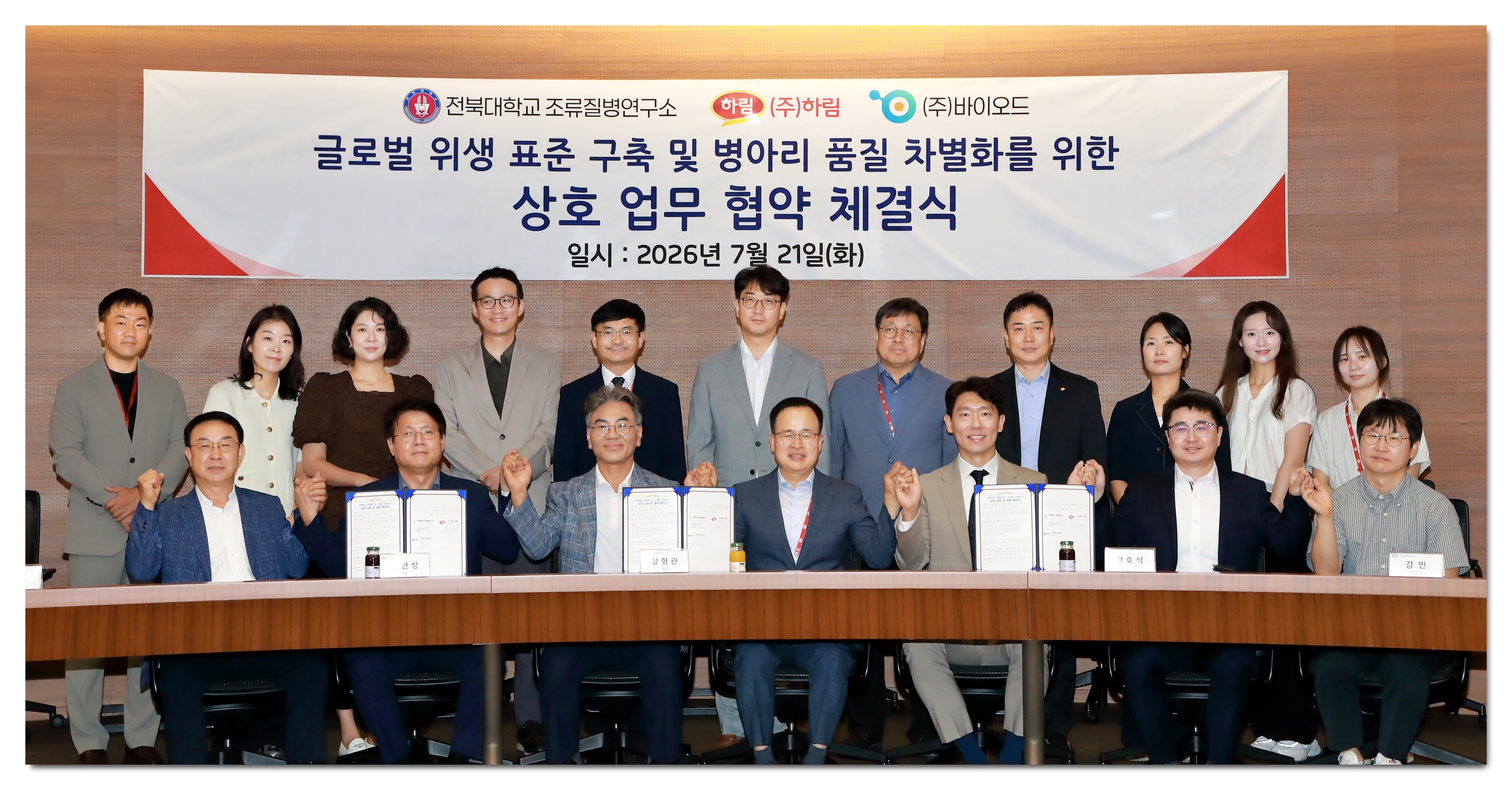
전북대학교 조류질병연구소(소장 장형관)가 종합식품기업 ㈜하림, 동물용 의약품 개발 전문기업 ㈜바이오드와 손잡고 글로벌 위생 표준 구축과 병아리 품질 차별화에 나선다.
전북대 조류질병연구소는 21일 하림 본사 4층 대회의실에서 하림, 바이오드와 ‘하림 병아리 품질 차별화 기술 도입’을 위한 다자간 업무협약(MOU)을 체결했다고 밝혔다.
협약식에는 장형관 전북대 조류질병연구소장과 위백 교수, 정호석 하림 대표이사, 강민 바이오드 대표이사, 박태욱 바이오드 CRO 부문장 등 산학연 관계자들이 참석했다.
협약에 따라 전북대 조류질병연구소는 병아리 품질 차별화 기술 도입을 위한 2단계 사업을 주관하고 본격적인 연구에 착수한다. 사업기간은 2029년 5월 31일까지 3년이다.
이번 사업은 연구소가 축적해 온 첨단 질병진단 및 방역기술을 하림이 보유한 국내 최대 규모 가금 생산 인프라에 적용·표준화하는 원천기술 적용 프로젝트다. 이를 통해 가금 사육과 부화 단계 전반의 위생·질병 관리 수준을 고도화하고, 국내 가금산업의 국제 경쟁력을 높인다는 계획이다.
연구소는 우선 농장과 부화장의 위생 등급에 따른 방역관리 표준서를 정립하고, 살모넬라 프리(Salmonella-free) 인증체계 도입을 추진한다.
또한 마렉병 표준진단 프로토콜을 구축하고, 이를 국가 표준진단법으로 등재하는 방안도 추진한다. 조류인플루엔자(AI)와 전염성기관지염(IB) 복합감염에 대응할 수 있는 차세대 ‘부화장 백신 플랫폼’의 현장 실증과 임상평가도 총괄해 백신 방역의 효과와 과학적 신뢰성을 검증할 예정이다.
장형관 전북대 조류질병연구소장은 “이번 협약은 대학 연구소의 독보적인 질병 통제 원천 기술이 산업 현장의 위생 기준을 바꾸는 산학연 협력의 선도적 모델”이라며 “살모넬라 발생 비율을 0.5% 미만으로 낮추는 등 청정 계군 확립을 위한 공인 인증체계를 구축하여 국내 축산 방역의 글로벌 표준을 정립하겠다”고 포부를 밝혔다.
정호석 하림 대표이사는 “전북대 조류질병연구소의 검증된 기술력과 방역 컨설팅을 통해 위탁사육 농가가 질병 위험을 줄이고 사육에 더욱 전념할 수 있는 선순환 생태계가 조성될 것으로 기대한다”며 “안전하고 품질 높은 병아리 생산 체계를 갖추는 데 적극 협력하겠다”고 밝혔다.
Center for Avian Disease, Harim Co., Ltd. and Others to Establish 'K-Poultry Biosecurity' Standards
Jeonbuk National University (JBNU) Center for Avian Disease (Director Jang Hyung-kwan) has joined forces with integrated food company Harim Co., Ltd. and animal drug development specialist BioD Co., Ltd. to establish global hygiene standards and differentiate chick quality.
JBNU Center for Avian Disease announced on the 21st that it signed a multilateral memorandum of understanding (MOU) with Harim and BioD at the Conference Room on the 4th floor of Harim's headquarters to introduce Harim's chick quality differentiation technology.
The signing ceremony was attended by Jang Hyung-kwan, Director of the JBNU Center for Avian Disease, Professor Wi Baek, Jeong Ho-seok, CEO of Harim, Kang Min, CEO of BioD, Park Tae-wook, Head of the CRO Division at BioD, and other representatives from industry, academia and research.
Under the agreement, the JBNU Center for Avian Disease will lead a two-stage project to introduce chick quality differentiation technology and will commence full-scale research. The project period is three years, through May 31, 2029.
The project applies and standardizes the advanced disease diagnostic and biosecurity technologies the center has accumulated to Harim's domestically largest poultry production infrastructure. Through this, it aims to enhance hygiene and disease management across rearing and hatchery stages and to raise the international competitiveness of the domestic poultry industry.
The center will first establish a biosecurity management manual based on hygiene grades of farms and hatcheries and will promote the introduction of a Salmonella-free certification system.
It will also develop a standard diagnostic protocol for Marek's disease and pursue its registration as a national standard diagnostic method. The center will oversee field demonstration and clinical evaluation of a next-generation "hatchery vaccine platform" capable of responding to co-infections of avian influenza (AI) and infectious bronchitis (IB), in order to verify the effectiveness and scientific reliability of vaccination-based disease control.
Jang Hyung-kwan, Director of the JBNU Center for Avian Disease, said, "This agreement is a leading model of industry–academia–research cooperation in which a university research center's unique disease-control core technologies change industry hygiene standards. We will establish an accredited certification system to secure clean flocks—reducing Salmonella incidence to below 0.5%—and set a global standard for domestic livestock disease control."
Jeong Ho-seok, CEO of Harim, said, "Through the JBNU Center for Avian Disease's proven technologies and biosecurity consulting, we expect to create a virtuous cycle in which contract rearing farms reduce disease risks and can focus more on rearing. We will actively cooperate to establish a safe, high-quality chick production system."
- 첨부파일